ViralSpin Academy
Related Reading
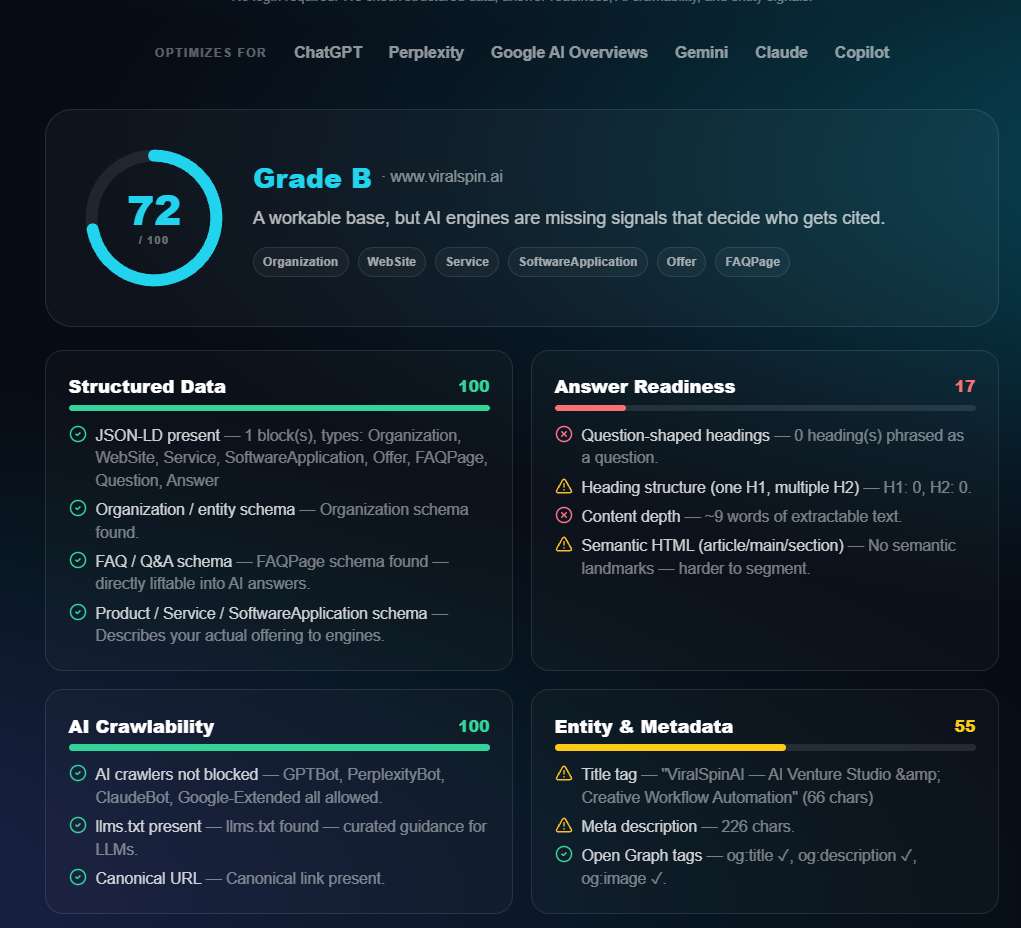
Before applying any of these tactics, run a free AEO audit at viralspin.ai/aeo to see your baseline score. It shows exactly which of the 4 pillars is blocking you.
How to Get Your SaaS Cited by ChatGPT, Claude, and Perplexity in 2026
 AITechDad
•
Updated August 2026
AITechDad
•
Updated August 2026
Someone asks ChatGPT "what's the best tool for AI video creation?" Your competitor gets mentioned. You don't.
It's not random. And it's not about who has more backlinks.
Here's the system behind AI citations — and how to get into it.
The citation algorithm is not PageRank
Let's start with the most important mindset shift.
Google ranks pages based on a link graph — who points to you, and how authoritative those sources are. That's PageRank. It's a reputation system built on references.
AI citation doesn't work that way.
When Claude, ChatGPT, or Perplexity decide which tools or sources to mention in an answer, they're drawing on a different signal set:
- Entity clarity — does the AI have a coherent model of who you are and what you do?
- Answer shape — does your content look like an answer to the question being asked?
- Crawl access — can the AI's live crawler actually read your pages?
- Training presence — are you mentioned in the sources that trained the model?
- Citation of the cited — are the sources that AI already cites, citing you?
Backlinks help with the last two indirectly. But you can have zero backlinks and get cited consistently if you nail the first three.
And you can have thousands of backlinks — like many established SaaS companies do — and be completely invisible in AI answers because your content isn't answer-shaped.
Tactic 1: Add FAQPage schema to every key page
This is the single highest-leverage AEO move most companies can make in an afternoon.
FAQPage schema is JSON-LD markup that explicitly tells AI crawlers: here is a question, here is the answer. It's the most direct feed you can give an AI engine.
What it looks like:
{
  "@context": "https://schema.org",
  "@type": "FAQPage",
  "mainEntity": [{
    "@type": "Question",
    "name": "What is answer engine optimization?",
    "acceptedAnswer": {
      "@type": "Answer",
      "text": "Answer engine optimization (AEO) is the practice of optimizing your brand and content to appear in AI-generated answers from tools like ChatGPT, Claude, and Perplexity."
    }
  }]
}
Where to add it: homepage (brand-level FAQs), pricing page (plan comparison questions), product pages (feature-specific FAQs), and any pillar content.
The questions should exactly match how your customers actually ask about your product. Mine those from your support tickets, sales call recordings, and the "People Also Ask" section on Google for your category.
Tactic 2: Rewrite your H2s as questions
Most SaaS sites write headers like this:
- "How It Works"
- "Key Features"
- "Why ViralSpin"
None of those match how someone asks an AI a question. Rewrite them as:
- "How does AI video generation work?"
- "What features does ViralSpin include?"
- "Why do founders choose ViralSpin over hiring a video editor?"
The H2 is a semantic signal. AI engines are trained on question-answer patterns. When your H2 is a question and the content under it answers it concisely, you're handing the AI exactly what it's looking for.
Tactic 3: Allow AI crawlers in robots.txt
This one should be obvious. But a huge percentage of SaaS companies are blocking AI crawlers — often because they added a blanket disallow rule at some point, or because their CDN or WAF is blocking non-browser user agents.
Check your robots.txt right now. You should see:
User-agent: GPTBot
Allow: /

User-agent: PerplexityBot
Allow: /

User-agent: ClaudeBot
Allow: /

User-agent: Google-Extended
Allow: /
If you're blocking these bots, ChatGPT cannot read your live pages. It will cite your competitors who aren't blocking them.
The fear that "bots will steal my content" is real but misplaced for most SaaS companies. Your product is your moat — not the words on your marketing page. Let the AI read it.
Tactic 4: Add llms.txt to your root
llms.txt is an emerging standard (similar to robots.txt but for AI systems) that gives LLMs a curated map of what's on your site.
A basic llms.txt at yourdomain.com/llms.txt looks like:
# ViralSpin

> AI video creation platform. Turn talking-head footage and B-roll into polished vertical shorts.

## Key pages
- [Product overview](https://viralspin.ai): What ViralSpin does
- [AEO audit tool](https://viralspin.ai/aeo): Free AI-visibility audit
- [MCP integration](https://mcp.viralspin.ai): Connect ViralSpin to Claude Code
- [Resources](https://viralspin.ai/resources): Guides on AI video and AEO
It's a 20-line text file. It costs nothing to add. And it signals to AI systems that you're aware of and cooperative with AI crawling — which is itself a positive signal.
Tactic 5: Get on Wikipedia or Wikidata
This feels like a 2010 tactic. It's one of the most powerful AEO levers in 2026.
Wikipedia is a primary training source for every major LLM. If your brand, category, or founder appears on Wikipedia — even briefly, in a "notable companies" list — that text becomes part of the model's base understanding.
Wikidata is even more accessible. It's a structured knowledge graph where you can add an entity for your company with: name, description, founding date, category, URL, social profiles. No article needed.
For larger companies: a Wikipedia article about your category that mentions you as a notable example is worth more than most SEO campaigns.
For earlier-stage companies: a Wikidata entity + mentions in existing Wikipedia articles about your category (through legitimate, factual additions) is achievable and high-impact.
Tactic 6: Get cited by sources that AI already cites
AI citation is partially a social graph problem.
When Perplexity or Claude answer a question about AI video tools, they're pulling from a set of sources they already trust. If those sources mention ViralSpin, ViralSpin starts to appear in the answer.
This means: - Getting reviewed by G2, Capterra, Product Hunt (AI engines cite review platforms heavily) - Getting covered in newsletters that AI engines pull from (Lenny's Newsletter, The Rundown, TLDR) - Guest articles on publications that are in the training data (Substack, Medium, HackerNoon, dev.to) - Being listed in curated tool directories that rank for "[category] tools" queries
The goal isn't traffic from those placements — it's the citation signal. A mention in a source AI trusts is worth more for AEO than 50 direct backlinks.
Tactic 7: Add brand mentions to training-adjacent content
This is the most forward-looking tactic.
AI models are retrained and updated continuously. The content they see during that process becomes part of their world model.
The practical implication: publishing high-quality, opinionated content on platforms that AI crawlers index frequently — LinkedIn, Substack, dev.to, your own blog — compounds over time. Each piece that mentions your brand in a relevant context is another data point building your entity authority.
This is why thought leadership content matters for AEO in a way it never quite did for SEO. You're not trying to rank a blog post. You're trying to build a coherent model of your brand in AI systems' understanding.
The mistakes killing your citation rate
Blocking GPTBot. If you've done this, fix it today. It's the fastest single fix to improve ChatGPT citation.
All prose, no structure. Blog posts written as flowing narrative are hard for AI to extract answers from. Add H2 questions. Add FAQs. Add TL;DR sections.
Inconsistent brand naming. If you're "ViralSpin" in some places and "Viral Spin" or "viralspin.ai" in others, AI engines build a weaker entity model. Pick a canonical name and use it everywhere.
No schema on key pages. Most SaaS companies have schema only on their blog posts (from WordPress plugins) and nothing on their product or pricing pages. Fix this.
Jargon-heavy copy. AI engines are trained on clear, direct language. If your homepage says "we leverage a synergistic content intelligence platform," the AI doesn't know what you do. If it says "we turn raw footage into polished short videos using AI," it does.
What to measure
AEO requires different metrics than SEO:
- Citation frequency — how often does your brand appear in AI answers for your category? Test manually with representative queries in ChatGPT, Claude, and Perplexity.
- Citation context — when you appear, is it as a primary recommendation or a footnote?
- Competitor citation share — what percentage of AI answers in your category mention a competitor vs. you?
- Crawl access — are your key pages being fetched by AI crawlers? (Check server logs for GPTBot/PerplexityBot/ClaudeBot user agents)
ViralSpin Monitor tracks your AEO score weekly and benchmarks against competitors. See viralspin.ai/aeo to start with a free audit.
The 2027 prediction
Citation share will become a board-level metric by 2027 — the same way domain authority became a board metric around 2015.
CMOs will report "AI share of voice" alongside organic traffic. Investors will ask about it in due diligence. The category leaders in 2027 will be the ones who built citation authority in 2026 — when most of their competitors weren't paying attention.
The window is open right now.