ViralSpin Academy
Related Reading
Run a free AEO audit at viralspin.ai/aeo — you'll have your score, grade, and top 3 fixes in 60 seconds.
What Is Answer Engine Optimization (AEO)? The Complete Guide for 2026
 AITechDad
•
Updated August 2026
AITechDad
•
Updated August 2026
Your website ranks #1 on Google. But when someone asks ChatGPT the same question, your brand doesn't exist.
That's the AEO gap. And in 2026, it's costing companies more than they realize.
The search landscape just split in two
For 25 years, SEO meant one thing: rank higher on Google.
That era isn't over. But it's no longer the whole game.
In 2026, a significant and growing portion of informational queries are answered directly by AI — ChatGPT, Claude, Perplexity, Gemini, Copilot. The user never clicks a blue link. They read the answer, maybe follow up with a question, and move on.
If your brand isn't in that answer, you weren't consulted.
That's the problem AEO solves.
AEO vs SEO vs GEO — what's the difference?
These three disciplines sound similar. They're not.
SEO (Search Engine Optimization) — Getting your pages to rank in Google/Bing search results. Measured by position, clicks, organic traffic. Driven by backlinks, technical health, and keyword relevance.
GEO (Generative Engine Optimization) — A broader term for optimizing across all AI-powered interfaces, including search-integrated AI features (Google AI Overviews, Bing Copilot). GEO is the category; AEO is the practice.
AEO (Answer Engine Optimization) — The specific discipline of making your brand, content, and entity citable in AI-generated answers. Measured by citation frequency, brand mentions in AI outputs, and answer-share. Driven by entity authority, structured data, and answer-shaped content.
The key difference: SEO optimizes for discovery. AEO optimizes for inclusion in the answer itself.
Why AI answers are replacing page-1 clicks
Here's what changed.
2022: AI chatbots were curiosities. Professionals used Google for research.
2024: Perplexity launched as a serious research tool. ChatGPT added browsing. AI Overviews started appearing in Google results.
2026: The workflow shift is complete for a large segment of knowledge workers. When someone wants to know "what's the best AEO tool," "how do I add schema markup to my site," or "explain answer engine optimization" — they ask Claude or ChatGPT first.
The result: zero-click answers are no longer just a Google problem. They're an AI problem. And unlike Google's featured snippets, AI answers don't always show a source. They synthesize — pulling from training data, live search, and their internal model of "who the authoritative sources are."
Getting into that model is the job of AEO.
The 4 pillars of AEO
There is no single lever that gets you cited by AI engines. It's a stack. Here are the four pillars, in order of impact:
1. Structured Data
Schema.org markup tells AI crawlers exactly who you are and what you do — without them having to infer it from prose.
The most important schema types for AEO:
- Organization — name, URL, description, logo, founding date, social profiles
- FAQPage — question/answer pairs that AI engines pull directly
- Product / SoftwareApplication — for SaaS tools specifically
- Article / HowTo — for content that should be cited in how-to answers
Most sites have no schema at all, or only the auto-generated minimum from their CMS. That's a structural invisibility problem.
2. Answer Readiness
AI engines are answer-shaped. They're trained on question-answer pairs. Content that mimics that shape gets extracted.
What answer-ready content looks like: - H2s written as questions ("How does X work?" "What is the difference between X and Y?") - Concise, definitive answers in the first 2–3 sentences under each heading - Content depth that goes beyond surface-level — AI engines learn to cite sources that consistently go deeper - No jargon without definition — if an AI engine can't understand your sentence, it won't cite it
3. AI Crawlability
This is the most technical pillar — and the one most companies get completely wrong.
Key checks: - GPTBot allowed in robots.txt — OpenAI's crawler; blocking it means ChatGPT can't read your live pages - PerplexityBot allowed — Perplexity's crawler; many sites block all bots by default - ClaudeBot allowed — Anthropic's crawler - llms.txt present — the emerging standard for telling AI systems what your site contains (similar to sitemap.xml but for LLMs) - Core Web Vitals — pages that load slowly or have broken mobile rendering get deprioritized
4. Entity & Metadata
AI engines build an internal model of "who is authoritative on this topic." That model is shaped by:
- How consistently your brand appears across citations (are you a source others reference?)
- Whether your title tags and meta descriptions define your brand in a way that matches how people ask about you
- Social card consistency — when your URL is shared in Slack, Discord, or social media, does the preview reinforce your entity?
- Wikipedia or Wikidata presence (for larger brands) — these are high-trust sources that anchor entity understanding
What an AEO score looks like
The ViralSpin AEO audit grades sites A through F across all four pillars:
| Grade | Score | What it means |
|---|---|---|
| A | 85–100 | Strong across all 4 pillars. Likely already appearing in AI answers. |
| B | 70–84 | Good fundamentals. 1–2 gaps preventing consistent citation. |
| C | 50–69 | Partial implementation. Appearing in some answers but missing structured signal. |
| D | 30–49 | Major gaps. AI engines can find you but don't cite you. |
| F | 0–29 | Invisible to AI. Likely blocking crawlers, no schema, no answer-shaped content. |
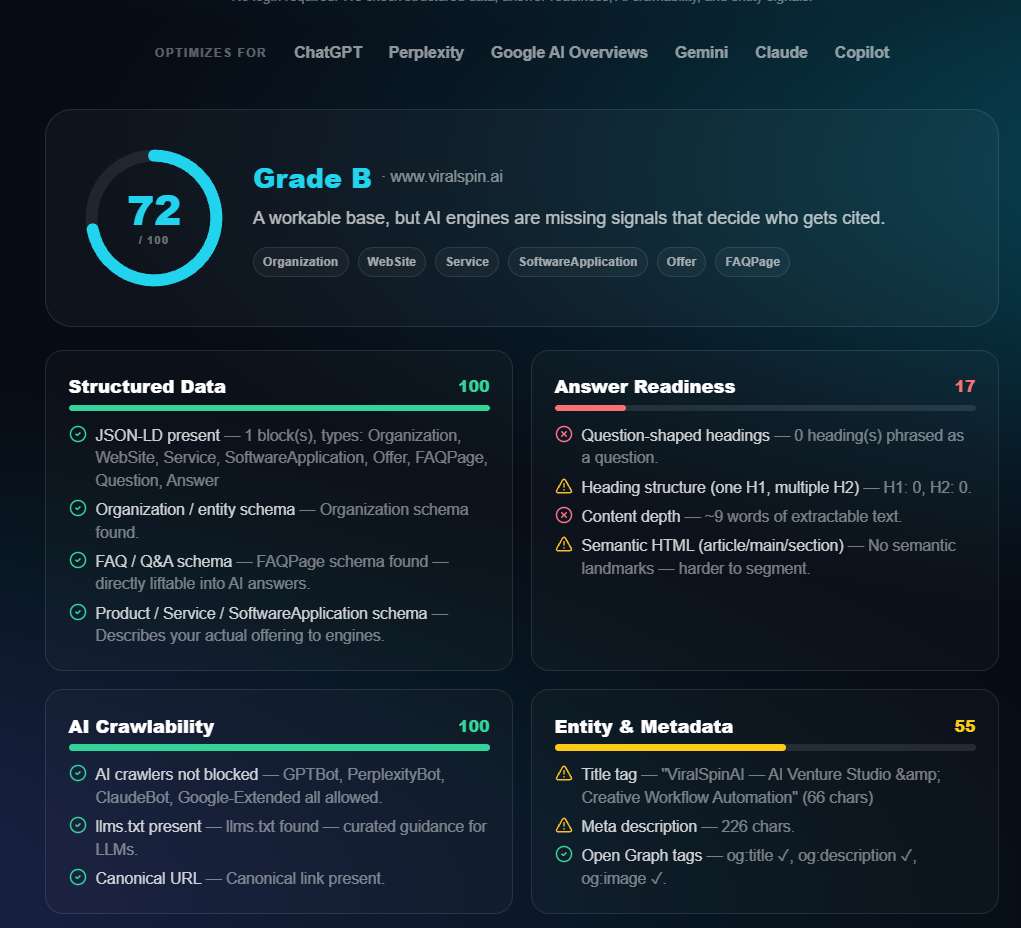
Most SaaS companies in 2026 score in the C–D range. They have decent SEO, some blog content, maybe a basic FAQ — but nothing that was built for AI citation.
Common mistakes in 2026
Treating AEO like SEO. Backlinks don't make you citable. Answer shape does.
Blocking AI crawlers to "protect content." If GPTBot can't read your site, ChatGPT will cite your competitor instead.
Writing for humans only. Content that's dense, jargon-heavy, or organized around narrative flow doesn't get extracted well. AI needs structure.
Ignoring schema because "it's too technical." FAQPage schema is 20 lines of JSON-LD. It's the single highest-leverage AEO fix most sites can make in an afternoon.
Treating citation as a traffic metric. AEO isn't measured in clicks — it's measured in brand authority. Someone who gets a Claude answer that mentions your tool twice is more likely to search for you directly. That's a different funnel than SEO.
What 2027 looks like
By mid-2027, we expect AI search to handle 40% of all informational queries — questions with a factual or research intent.
That means 40% of the time someone is trying to learn something, evaluate a product, or solve a problem — they're asking an AI first, not opening a browser tab.
The companies building AEO infrastructure now are building a moat. Citation share compounds. Once AI engines learn your brand is authoritative on a topic, they cite you more → you get more brand mentions → you become more authoritative.
The companies ignoring AEO now will spend 2027 trying to reverse invisibility that built up over two years.
How to start
- Audit your current score — free at viralspin.ai/aeo
- Fix crawlability first — allow GPTBot, PerplexityBot, ClaudeBot in robots.txt; add llms.txt
- Add FAQPage schema — the single fastest lift for answer inclusion
- Rewrite 5 of your top pages with question-shaped H2s and concise answer paragraphs
- Monitor your citation share — the ViralSpin Monitor plan tracks weekly AI visibility and competitor share-of-voice
AEO isn't a project. It's an ongoing practice — just like SEO was.
The difference is: the companies who figured out SEO early in 2010 dominated their categories for a decade. That window is open right now for AEO.