Skin Physics:
Mastering Texture & SSS.
 AITechDad
•
15 MIN READ
•
BIOLOGICAL PHYSICS NODE
AITechDad
•
15 MIN READ
•
BIOLOGICAL PHYSICS NODE

The Anatomy
of Realism.
"Why does my AI avatar look like a plastic doll? I used '8k, hyper-realistic, photorealistic'—but it still feels 'dead' behind the eyes."
This is the Uncanny Valley. It’s the gap where an image is 99% human, but that final 1% is so jarringly artificial that your brain rejects it. In the world of high-authority content, this "Plasticky" look is the mark of an amateur.
To cross the valley, you have to move beyond artistic prompts and start prompting for Biological Physics. Specifically, you need to master the interaction between the Outside of the skin (Texture) and the Inside of the skin (Subsurface Scattering).
1. Skin Texture: The Outside
The Epidermal Blueprint
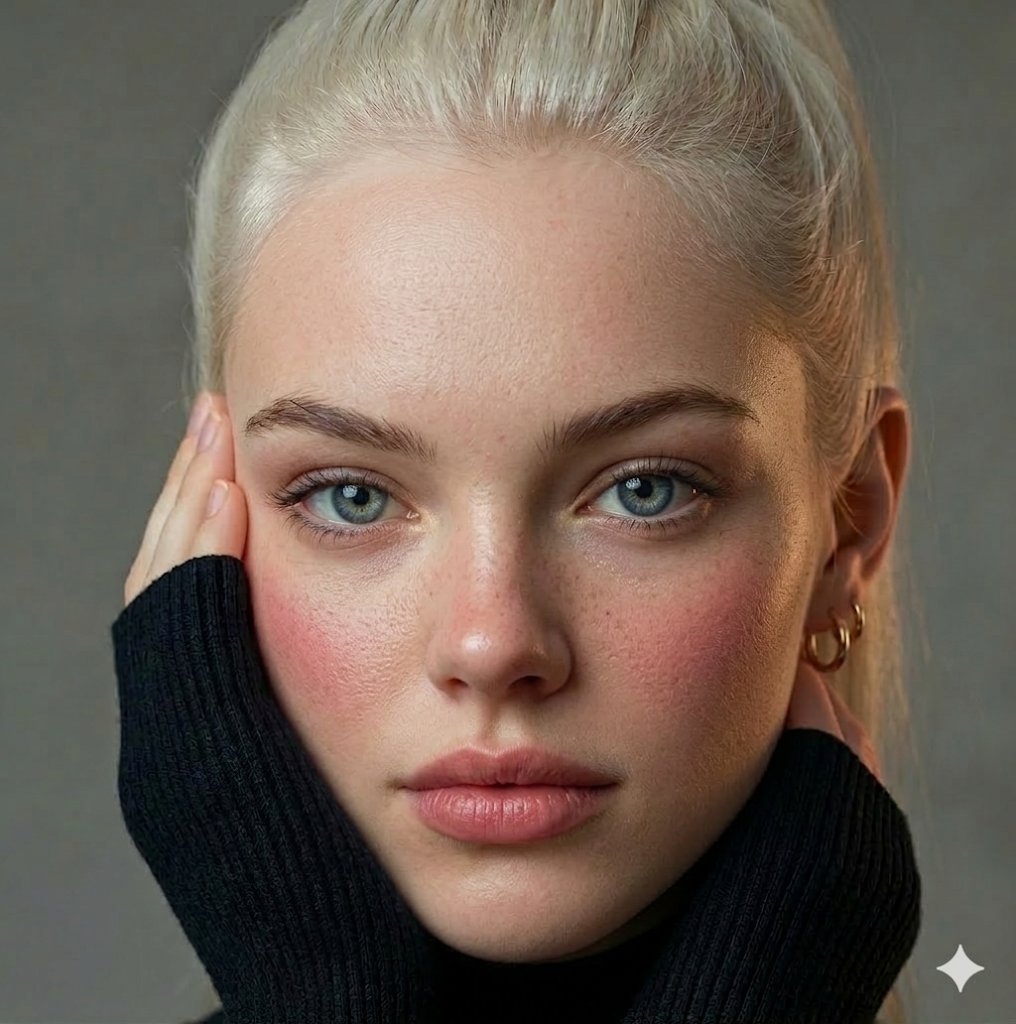
Skin Texture is everything that happens at the macroscopic level: the pores, fine hairs, wrinkles, moles, and "micro-bumps" that break up the surface.
Without texture, skin looks like a smooth egg. It reflects light like a perfect sphere, which is why it looks like plastic. Real skin is a landscape of tiny imperfections that scatter light in a million directions.
OUTSIDE The Vocabulary
- "Visible pores" – Adds the micro-anchor points for light.
- "Fine skin grain" – Prevents the "Denoised" smooth AI look.
- "Hyper-detailed epidermis" – Forces the model into high-frequency detail.
The "Viral" ROI
When you add texture, you aren't just making it "sharp." You are giving the viewer's brain the Evidence of Reality. The human eye is evolved to spot "too perfect" skin as a sign of illness or artificiality.
2. Subsurface Scattering: The Inside
AITechDad's Take
The "Texture vs. SSS" Trap
"I’ve had creators tell me they actually prefer skin Texture on its own. They love the 'razor-sharp' pores and hairs. And I get it—it looks visceral. But here is the danger: Without SSS, your character becomes a hyper-detailed Stone Statue. SSS is the 'Pulse.' It's the warmth in the shadows and the light in the ears that tells the viewer's brain: This isn't CGI, this is a living, breathing human."
Even if you have perfect texture, an image can still look "dead." It starts to look like a highly detailed stone statue or dry clay. Why? Because you've ignored the Inside.
Subsurface Scattering (SSS) is the phenomenon where light travels through a translucent material, scatters around inside, and then exits at a different point.
The "Flush of Life"
SSS is what adds that slight "flush" or warmth to the shadows. It reveals the blood vessels and tissues underneath the skin. It’s why your ears glow red when the sun is behind them. Without SSS, there is no "glow," and therefore, no "life."
INSIDE The Vocabulary
- "SSS" / "Subsurface Scattering" – The core physics term.
- "Skin translucency" – Defines how much light gets in.
- "Dermal light transport" – Forces biological-level simulation.
Pro Insight
SSS is more visible in thin areas: the ears, nostrils, and the webbing between fingers. If those areas are harsh and black, your SSS is failed.
The Case Study: 4-Panel Evolution
To see this in action, we analyze the evolution of a single AI portrait using our specialized prompts. This is the difference between an accidental render and a Viral-Tier authority piece.
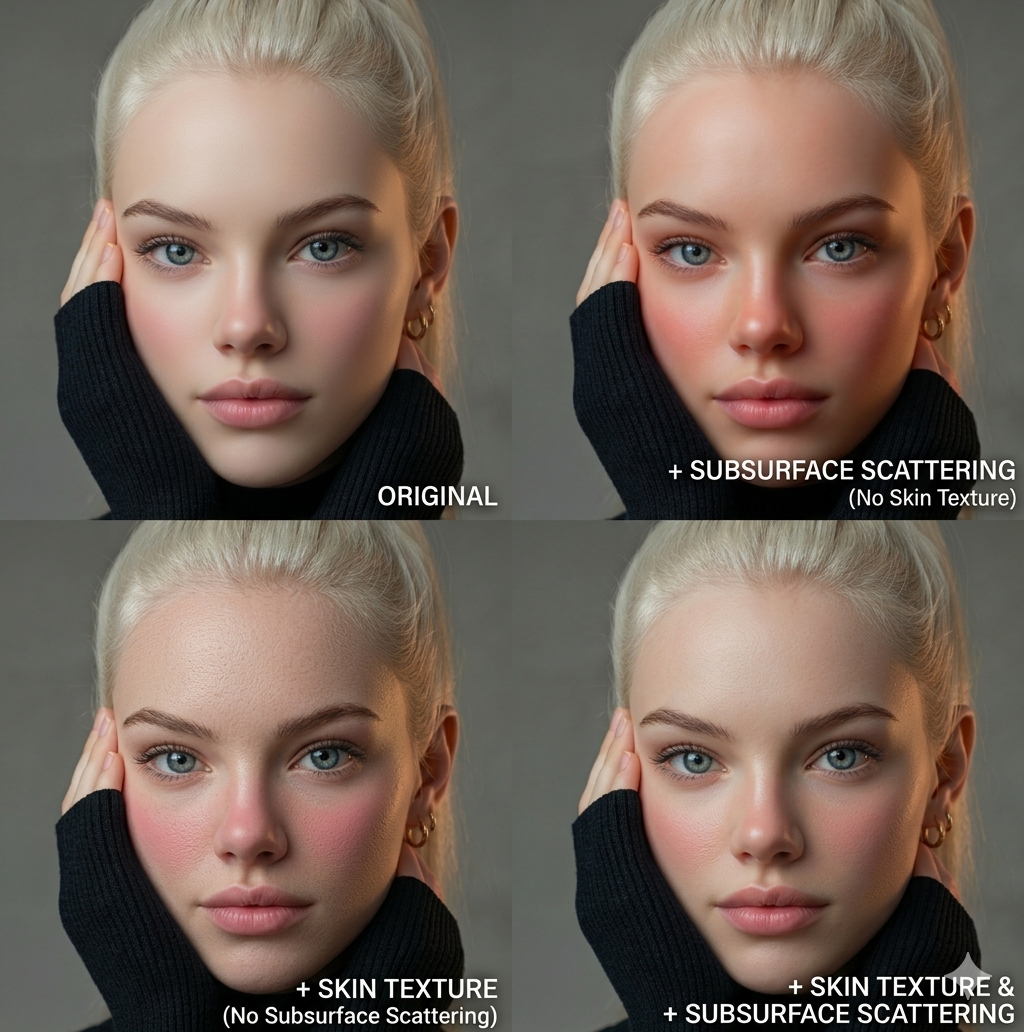
Comparison A: The Component Breakdown
- Original: The "Plasticky" baseline. Smooth, doll-like, and artificial.
- + SSS: Notice the softness in the shadows and the "inner glow." It feels warmer, but still slightly "unfocused."
- + Skin Texture: The surface is sharp and detailed, but it feels like "8k Dry Clay"—sharp, but dead.
- + Both: The Authority Standard. The light breaks on the surface (Texture) and penetrates for warmth (SSS).
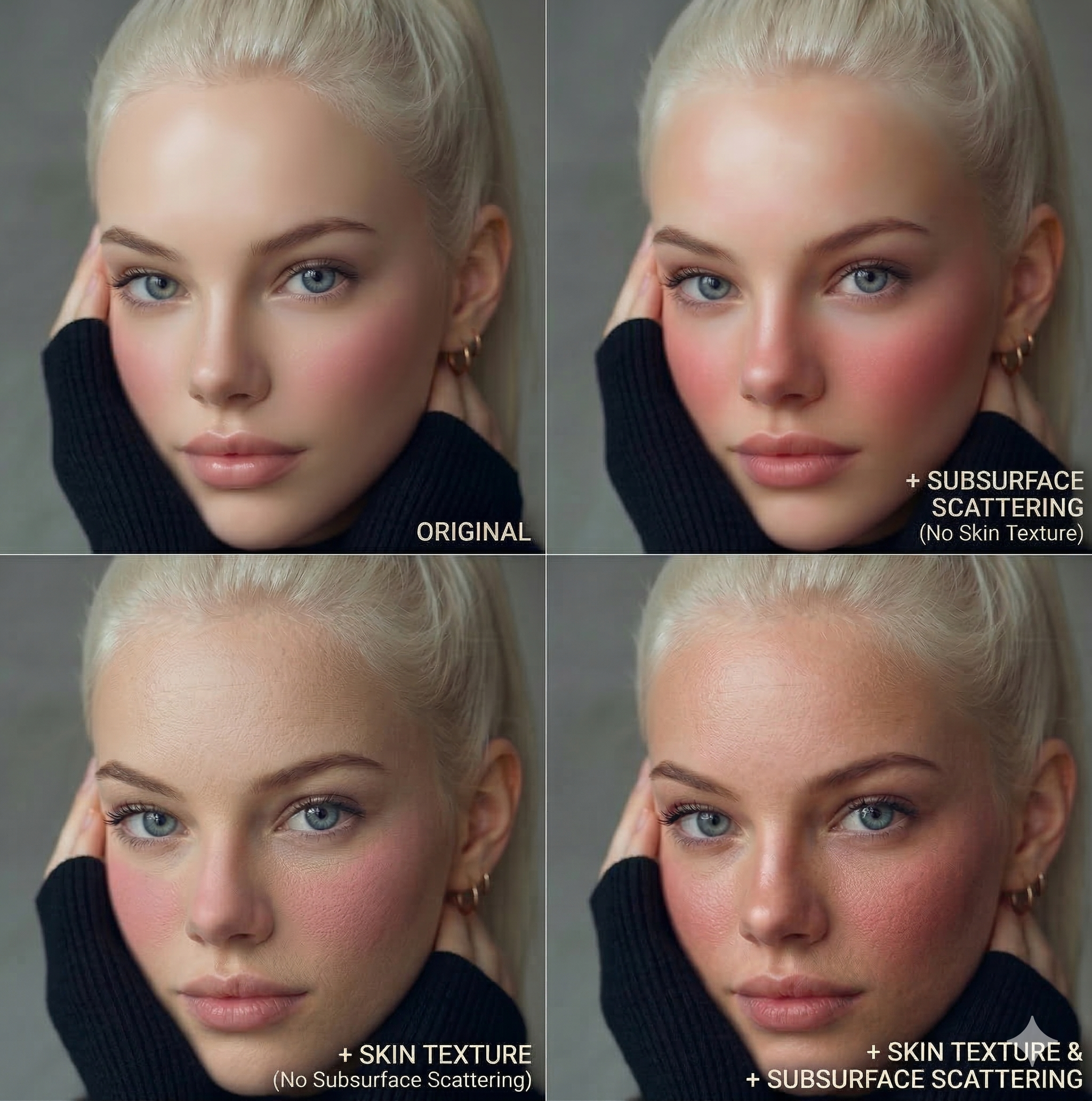
Comparison B: Intensifying the Authority
In this version, we’ve pushed the intensity. Notice the "Soft Flush" on the nose and cheeks. This isn't makeup; it's a simulation of blood flow and light diffusion.
The "Reverse Prompt" Audit
When analyzing high-end video (Sora/Veo), ask yourself: "Is the skin reflecting or penetrating?"
-
Specular Reflection (The Shiny Bit)
Look at the nose bridge and cheekbones. If the light is "crisp" and "dewy," that is Reflection off surface oils.
-
Internal Glow (The Life Bit)
Look at the shadows. If they contain warm, pink/orange tones instead of harsh black, that is SSS revealing the life underneath.
Get the Visual DNA Prompt Pack
Download our free guide including 5 Cinematic Lighting Prompts and the 2026 Software Stack used by elite creators.
Technical Workflows: When to Prompt
Do you need these 30-word strings for every prompt? No.
TIER 1: The Average User
Midjourney / Sora / Veo
A simple "photorealistic portrait" or "cinematic studio lighting" is often sufficient. These models have internalize SSS logic automatically.
TIER 2: The Authority Pro
Technical Directing / Custom Prompts / Analysis
In advanced workflows, you must explicitly dictate these terms. If your render comes out "flat," this is your Emergency Override:
"+ skin texture + subsurface scattering"
Master the Visual DNA
Biology is the final boss of AI realism. If you want the full Technical Blueprint—including our 'Visual DNA' Prompt Pack—join the elite creators today.
Unlock the Authority Stack